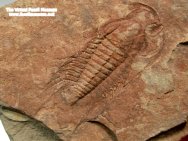
The
Kaili Biota of Guiznou Province China, like the fantastic Chengjiang
Biota of the Maotianshan Shales and Burgess
Shale Fauna, is a Lagerstatte preserving
some of the earliest radiations of complex life known on the
planet.
The formation is some 220
m in thickness and spans the Late Early to Early Middle Cambrian
(some 513 to 501 million years old). As such it is intermediate
in age between the Changjiang and
Burgess Shale Faunas. Representatives of some 110 genera are
known, representing 11 phyla. The Kaili Biota includes both
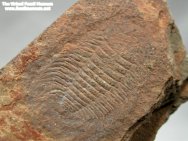
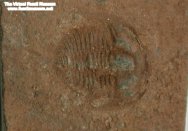
soft-bodied and skeletonized animals, and is dominated by trilobites.
It shares roughly 30 genera in common with Chengjiang and
nearly
40 with the Burgess Shale. Trilobites
and eocrinoids with hard parts that are faily easily preserved
are the most common fossils, but many animals with only soft
tissues
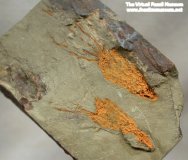
are also preserved, including naraoiids,
Microdictyon, Wiwaxia, and Marrella. There are a number of
eocrinoid
Echinoderms,
with three members of the gogiid genus Sinoeocrinus predominating.
The Echinoderms remained a modest component of the Cambrian
biota until favorable environmental shifts allowed for their
rapid
radiation. A second location has been found some 100 km to
the southwest of the original site recently, affording additional
opportunities to study this diverse faunal assemblage. The
presence of Burgess Shale–like fauna over a large part
of southwestern China shows that the faunal community was
quite cosmopolitan
in nature, indicating that fossil
preservation was more of a factor in finding these concentrations
of animals than was the existence of isolated communities
suitable
for harboring these myriad life forms. Indeed, some researchers
believe that high rates of uplift and erosion led to increased
deposition of fine sediments in the continental margins, making
such exquisite preservation possible. As a consequence, some
deem the stepwise evolution of
life as more illusion than fact. Whatever the case, these
and
future discoveries will go a long way towards providing a clearer
picture of this wonderful time in the evolution of life on
earth
we call the Cambrian
Explosion.
Kaili
References