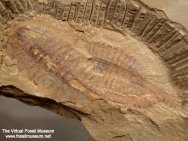
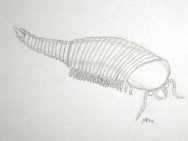
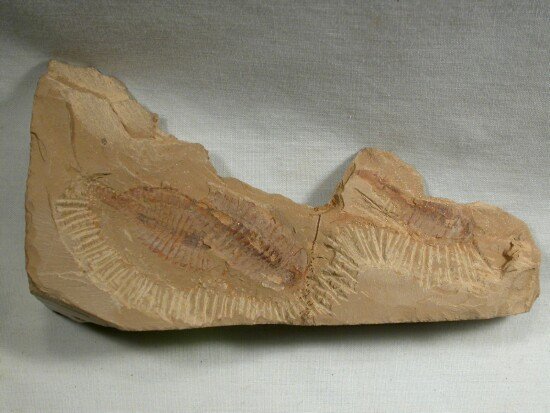
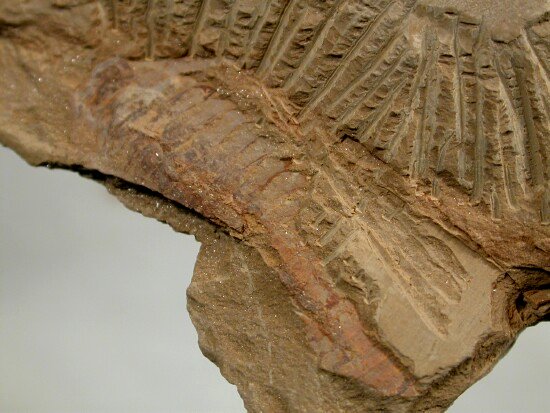
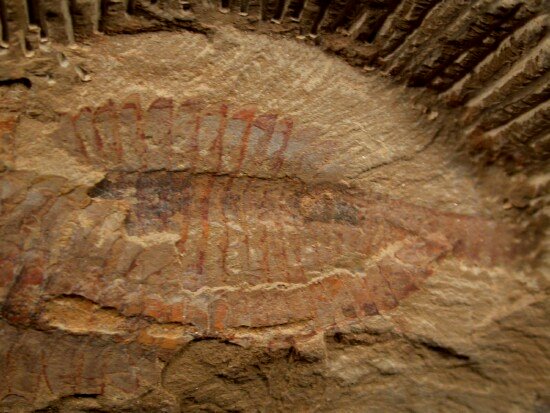
Fuxianhuia protensa
Phylum Arthropoda, Order Fuxianhuiida, Family Fuxianhuiidae
Geological Time: Early Cambrian (~525 million years ago)
Size: 32, 33, and 50 mm mm long on a 125 mm by up to 58 mm matrix
Fossil Site: Chengjiang Maotianshan Shale, Quiongzhusi Section, Yu’anshan Member, Heilinpu Formation, Maotianshan, Yuxi, Chengjiang County, Yunnan Province, China
|
Fuxianhuia's classification is one of the most disputed fossils from the site, with some considering it a euarthropod. The Chengjiang Biota discoverer and coworker erected a new family and a new superclass called Proschizoramia which was characterized as a group at any early stage in the evolution of arthropods with biramous limbs (hou, et al., 1987). Another early analysis described it as a stem group chelicerate (Will, et al., 1996). More recently, Ma et al. (2012) suggested that the head, brain and optic lobes had features simialar to a malacostracan (shrimp), chilopod and insect, and therefore that Fuxianhuia might precede their evolutionary split. Discovered
by Hou Xian-guang in 1984, the Chengjiang
Biota now
ranks as the most diverse faunal fossil assemblage of all the
Burgess Shale like deposits. It is also some 10 million
Also see: Cambrian Explosion References: Hou, X.-g (1987). "Three New Large Arthropods from Lower Cambrian, Chengjiang, Eastern Yunnan [In Chinese]". Acta Palaeontolologica Sinica 26: 272–285 Chen, JY; Edgecombe, G. D.; Ramsköld, L.; Zhou, L (1995). "Head segmentation in Early Cambrian Fuxianhuia: implications for arthropod evolution". Science 268 (5215): 1339–1343. Wills, M. A.; Edgecombe, G. D.; Ramsk ld, L. (1996). "Classification of the Arthropod". Science 272 (5262): 746–747. Ma, X.; Hou, X.; Edgecombe, G. D.; Strausfeld, N. J. (2012). "Complex brain and optic lobes in an early Cambrian arthropod". Nature 490 (7419): 258–261.
|