
Phylum Arthropoda
Phylum Arthropoda |
|
|
|||||||||||||||||||||||||||||||||||||||||||||||||||
The
Cambrian period saw the emergence of group of animals that
would conquer
the marine environments world wide and go on to make the first
pioneering steps onto land. Arthropods
comprise the creatures with jointed legs, from fleas to crabs
to the extinct trilobites to
the extant but primitive horseshoe crab. Since first appearing,
probably during the Precambrian,
their variability has been nothing short of astonishing, and
their
impact on the living
earth enormous. Arthropods (Greek for jointed feet) comprise
the largest phylum of animals and include the Arthropods
are most characterized by their jointed limbs and cuticles,
which are mainly made of a-chitin. The cuticles of
crustaceans
are also biomineralized with calcium carbonate, as was that of
the extinct trilobite. The cuticle is sufficiently inflexible
as to inhibit growth such that it must be periodically replaced
by molting, a characteristic that unites nine phyla in Superphylum
Ecdysozoa (Arthropoda, Onychophora, Tardigrada, Kinorhyncha,
Priapulida, Loricifera, Nematoda and Nematomorpha). The arthropod
body plan
consists of repeated segments, each with
a pair of appendages. The embryos of all arthropods are segmented,
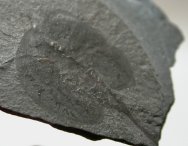
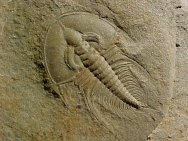
Parvancorina and Spriggina are Ediacaran animals from around 555 Mya that are among the earliest putative arthropods in the fossil record. Bivalve-like fossil shells have been found in China that date to some 541 to 539 million years ago. The earliest Cambrian trilobite fossils date to about 530 million years ago, but because they were already diverse and dispersed worldwide, they certainly must have already existed for a long period. Many arthropods are described from the Burgess Shale dating to some 505 million years ago. A large number of arthropods are also described from the older (525 to 520 million years) Chengjiang Maotianshan Shales. The earliest fossil crustaceans date to about 513 million years ago the earliest fossil shrimp to about 500 million years ago. The eariest identifiable body fossils of land animals are arachnids and chilopods from the late Silurian (419 million year ago) of England. Arthropod ichnofossils from the late Cambrian have been intertidal sand dune deposits in Canada and Wisconsin. Because of their beauty and their extensive availablity in the fossil record, the trilobite is the unequivocal favorite among fossil collectors. Though trilobites dominated the Paleozoic marine environments, came back strong after several mass extinctions, they faded out by the end of the Permian, their niches on various marine environments taken over by their crustacean cousins. The spiders thrived on land as did the insects. Insects underwent an amazing adaptive radiation. Excluding microbial organisms, modern times are dominated by the insects, with beetles alone making up some 25% of known organisms.
|
|||||||||||||||||||||||||||||||||||||||||||||||||||||

Fossil
Museum Navigation:
Home Geological Time Paleobiology Geological History Tree of Life Fossil Sites Fossils Evolution Fossil Record Museum Fossils |
