Evolution
of Plants:
The
chloroplasts of green plants are surrounded by two membranes,
supporting the theory of an endosymbiosis,
with cyanobacteria a common ancestor. Embryophytes descended
from green
algae during the Palaeozoic era, and are also called the land
plants (though some live in water) and include all the
trees,
flowers, ferns, mosses with which we are all familiar. All
are complex multicellular organisms with specialized reproductive
organs and, with rare exception, use photosynthesis for their
energy.
For
some 1.5 billion years, photosynthetic organisms remained
in the
sea,
protected from ultraviolent radiation. The earliest photosynthetic
organisms to invade land probably resembled modern
algae, cyanobacteria, and lichens, and were followed by the bryophyte,
including liverworts (Division Marchantiophyta) and mosses
(Division Bryophyta) that descended from the charophyte group
of green algae.
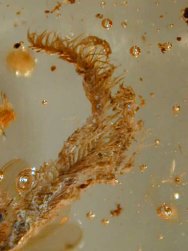 After
evolving from primitive green algae, plants probably began their
terrestrial invasion some 450 million years ago during the late
Ordovician, with a
first major evolutionary task being desiccation resistance. Vascular
structures emerged to transport water and nutrients to tissue
that was above the water. Symbiotic relationships with fungi emerged
to assist in the uptake of nutrients from moist soil, as opposed
to flooded soil. Later success was fostered by the evolution of
means for gamete
and After
evolving from primitive green algae, plants probably began their
terrestrial invasion some 450 million years ago during the late
Ordovician, with a
first major evolutionary task being desiccation resistance. Vascular
structures emerged to transport water and nutrients to tissue
that was above the water. Symbiotic relationships with fungi emerged
to assist in the uptake of nutrients from moist soil, as opposed
to flooded soil. Later success was fostered by the evolution of
means for gamete
and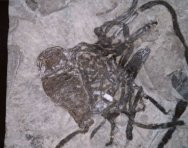 progeny dispersal in flowers and seeds among some, but not all,
plant lineages.
progeny dispersal in flowers and seeds among some, but not all,
plant lineages.
Land colonization by plants is believed to have been achieved
by around 425 Ma during the Silurian
with the appearance of the vascular plants. Cooksonia is usually
considered the earliest fossil of a vascular land plant; it
was
a small plant, only a few centimeters high. Its leafless stems
had sporangia (spore-producing structures) at their tips. No
specimen
has been found with roots suggesting it connected to the
ground with very fine root hairs.
As
plants evolved and spread across terrestrial landscapes, and
themselves
adapted to changing environments, they were a major selective
influence in paleobiology and
evolution of animals (co-evolution) from the time of their
prominence in the Paleozoic,
and through the Mesozoic
and Cenozoic.
Gymnosperms, and especially the cycads, were the dominant land
plants in the Jurassic, but the Cretaceous saw the rise
of the flowering plants (angiosperms) and their associated insect
pollinators (an example of co-evolution) became the dominant
plant form that continues to present day.
The
fossil record has been ambiguous since the time of Darwin as
to when and from what ancestors flowing plants arose. The oldest
undisputed flowing plant fossil dates to 125 million years
ago in the Cretaceous. However, modern genome sequencing of
plants with apparent primitive phenotypes and other evidence
suggest that the angiosperm lineage may begin with or near
a ginkgo-like plant from Liaoning China, Schmeissneria, in
the early to middle Jurassic (Wing, 2007). This origin is but
one of many competing hypotheses, but at present, there exists
some consensus that one or perhaps two whole genome duplications
in angiosperm ancestors enabled the evolutionary leap to flowers,
altering the earth and its ecosystems forever thereafter.
About Plants
In
the most general context, plants are at the bottom of
the majority
of terrestrial food chains, and through photosynthesis,
produce the energy for most of earth’s life, directly
or indirectly. Most oxygen essential for we eukaryotes
come from plants as their metabolic byproduct. The
amphibians followed the "amphibious" plants
onto land, as did the reptiles follow plants onto land.
Interestingly, the rise of mammals coincided with the rise
of
plants that, like mammals, utilize internal development by
enclosing embryos in a protective and nourishing shell,
the seed in the
case of plants. The number of plant species on earth can
only be estimated, and is believed to exceed three hundred
thousand (far and away mainly flowing plants), albeit, only
a limited number is suitable for domestication and human
food
consumption.
Plant
Evolution - Kingdom Plantae Classification Systematics and
Phylogeny
Kingdom
Plantae classification, systematics and phylogeny are
not settled science, and the tree of life for plants has undergone
major
revisions in recent years. There are many competing views and
hypotheses, with more revisions the assured outcome. Unraveling
the mysteries of plant evolution is being made possible by
now very inexpensive molecular whole genome sequencing across
the plant Kingdom. The history of plant life is all pretty
confusing, so we've tried to condense it in the
table
below, and provide succinct supporting summaries in the table
notes.
|
Viridiplantae or Green
Plants
|
Unranked
Groups or Subkingdoms |
Division |
| Green
Algae (Fomerly in now obsolete Kingdom Protista - see note
2) |
Chlorophyta |
| Charophyta |
Unranked Embryophytes
(Land Plants) - see note 1
|
Bryophytes
(Non-Vascular plants) |
Marchantiophyta
- liverworts |
| Anthocerotophyta
- hornworts |
| Bryophyta
- mosses |
| Horneophytopsida |
| Unranked Tracheophytes
(Vascular Plants - note 2) |
Non-seed-bearing plants |
Rhyniophyta - rhyniophytes |
| Zosterophyllophyta - zosterophylls |
| Lycopodiophyta
- clubmosses |
| Trimerophytophyta trimerophytes |
| Pteridophyta
- true ferns and horsetails |
| Progymnospermophyta
- whisk ferns |
| Unranked
Spermatophytes (seed plants - note 3) |
Gymnosperm
(note 4) |
Pteridospermatophyta
- seed ferns |
| Gymnosperms
Gymnospermae (notes 4 and 5) |
Pinophyta
- conifers |
| Cycadophyta
- cycads |
| Ginkgophyta
- ginkgo |
| Gnetophyta
- gnetae |
| Angiosperms
- flowering plants (notes 4 and 5) |
Magnoliophyta
- flowering plants (also called angiosperms, angiospermopsida) |
Notes:
- Importantly,
the embryophytes (or land plants) are believed to have
evolved from Charophyte green algae. Green algae and
the embryophytes together comprise the clade Viridiplantae (often
referred to simply as the green plants). Viridiplantae
are united by cells with cellulose providing structure,
and with cellular metabolic machinary having chloroplasts
evolved
from endosymbiosis with cyanobacteria.
Endosymbiosis is a well-supported theory explaining
the evolution of chloroplasts (in plants) and mitochondria
(in animals) in eukaryotic cells; in the simplest terms,
primitive eukaryotic cells hijacked photosynthetic
prokaryotic cells (probably proteobacteria eventually
leading to animal mitochondria and cyanobacteria leading
eventually plant plastids), fed them, and used their
photosynthetic
metabolic machinery
to
produce
their
energy aerobically,
burning
oxygen and respiring carbon dioxide in the process.
Estimated very wildly, but the seminal endosymbiotic
event is often hypothesized to have occured in Proterozoic
between 2000 and 1500 million years ago.
- Algae
were once considered to be in now obsolete Kingdom
Protista rather than Kingdom Plantae. There are several
different
groups
of algal organisms that are predominently photosynthetic.
Most
notable are seaweeds that are multicellular algae and
appear much like land plants, but are classified separately
as brown algae. Red multicellular algae is also no
longer contained in Plantae.
- Phylogeny
for modern Spermatophyta (seed plants) and some related
vascular plant groups is shown to the right (click the
image to enlarge). The spore-bearing vascular plants are
paraphyletic
with respect to the seed plants, with ferns (Pteridophyta)
more closely related to seed plants than they are to clubmosses
(Lycopodiophyta)

- Seed
plants span the fossil record with the seed ferns,
or
(Pteridospermae) once dominating and building entire
forests especially in the Upper Paleozoic. By the
Triassic period,
seed ferns were largely replaced by gymnosperms until
the Cretaceous, when the Angiosperms became dominant,
and underwent a massive diversity radiation.
- Gymnosperm
(Gymnospermae) is a name derived from the Greek word for
naked seed. They comprise a group of seed-bearing and
hence vascular plants whose seeds appear “naked”
on scales of a cone or, as opposed being formed within
an ovule and developing fruit, as is the case for the
angiosperms. The Pteridospermatophyta, or seed ferns,
is an extinct gymnosperm division that were predominant
in the Devonian. The systematic position of the Pteridospermatophyta
is currently in debate.
- The
angiosperms are the vast and major group of flowering
plants whose seeds are covered in a true fruit. The reproductive
organs are in a flower and the ovule is enclosed within
a carpel that will lead to a fruit.
Also see:
References:
- Davies, T. J. (2004). "Darwin's abominable mystery:
Insights from a supertree of the angiosperms". Proceedings
of the National Academy of Sciences 101 (7): 1904–9.
- Jiao, Yuannian; Wickett, No4rman J.;
Ayyampalayam, Saravanaraj; Chanderbali, André S.; et al. (2011). "Ancestral
polyploidy in seed plants and angiosperms". Nature
473 (7345): 97–100
- De Bodt, S., Maere, S. & Van de Peer, Y. Genome duplication
and the origin of angiosperms. Trends Ecol. Evol. 20, 591–597
(2005)
- Soltis, D. E., Bell, C. D., Kim, S. & Soltis, P. S.
Origin and early evolution of angiosperms. Ann. NY Acad.
Sci. 1133, 3–25 (2008)
- Fawcett, J. A., Maere, S. & Van de Peer, Y. Plants
with double genomes might have had a better chance to survive
the Cretaceous-Tertiary extinction event. Proc. Natl Acad.
Sci. USA 106, 5737–5742 (2009)
- Keith Adams (December 2013). "Genomic Clues
to the Ancestral Flowering Plant". Science 342 (6165):
1456–1457
- Xin Wing; Shuying Duan, Baoyin Geng,
Jinzhong Cui and Yong Yang (2007). "Schmeissneria: A missing link
to angiosperms?". BMC Evolutionary Biology 7: 14.
|
|