
Domains Archaea and Bacteria |
|
From the first dawn of life, all organic beings are found to resemble each other in descending degrees, so they can be classed in groups under groups. Charles Darwin, Origin of Species, Chapter 13 | |
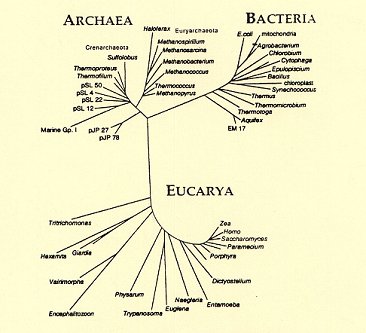
Emergence of the New Domain ArchaeaUntil the 1980's with the advent of genomic sequencing techniques, bacteria were the only recognized group of single-celled organisms to have procaryotic cells not containing a nucleus. Phylogenetics (see references 1-4 below) enabled the discovery of another group of prokaryotes that was initially and informally named "archaebacteria" (they were renamed Archaea since their genomes are far distant from that of bacteria). Actually, many archaeans had long been studied extensively, but with the idea that the archaea were bacteria; sequence analysis revealed that this group of prokaryotes needed placement within the Universal Tree of Life as a distinct Domain, alongside Bacteria and Eukarya. From Prokaryotes to EukaryotesProcaryotic cells are very tiny, 1 micron across, compared to 10 to 100 microns in most eucaryotic cells. Prokaryotes are found everywhere eukaryotes are found, as well as in many environments too extreme for eukaryotes. Instances of prokaryote and eukaryotes symbiosis abound. Despite their diminutive size, prokaryotes are the most abundant and ubiquitous form of life on Earth. They comprise some 90% of the total biomass in the seas. The organelles of eukaryotes (mitochondria in animals and chloroplasts in plants) are thought to be evolutionary descendents of Bacteria that invaded, or were captured by, primitive eukaryotes as early as 3500 million years ago in an evolutionary leap described by the theory of endosymbiosis. Numerous types of extant eukaryotic cells are inhabitated by endosymbiotic procaryotes. Prokaryotes exhibit an amazing diversity of types of metabolism to power themselves that is nonexistent in eukaryotes. For example, the metabolic processes of nitrogen fixation (conversion of atmospheric nitrogen gas to ammonia) and methanogenesis (production of methane) are unique to procaryotes and enormously impact the nitrogen and carbon cycles in nature. Most of the earth's atmospheric oxygen was produced by free-living bacterial cells.
Also see: Endosymbiosis |
|||
|
| ||||||
Fossil
Museum Navigation:
Home Geological Time Paleobiology Geological History Tree of Life Fossil Sites Fossils Evolution Fossil Record Museum Fossils |
