|  Discovered
in 1984, the Chengjiang Biota now ranks as the most diverse faunal
fossil assemblage of all the Burgess Shale like deposits. It
is also some 10 million years older than the Burgess Shale. Like
the Burgess Shale, non-mineralized soft tissue parts are often
extraordinarily well preserved with high resolution as aluminosilicate
films, sometimes with oxidized iron content. Various taphonomic
processes leading extensive preservation of soft tissue have
been proposed, including rapid death by asphyxia followed by
rapid burial in anoxic sediment undisturbed by turbidity. The
Chengjiang biota is dominated by phyla Arthropoda and Porifera.
There are seven lobopodians, more than any other Lagerstätte that some scientists elevate to phylum rank, and seven members
of the extinct phylum Vetulicolia. Members or potential members
of phyla Priapulida, Nematomorpha, Hyolitha, Hemichordata, Echinodermata,
Ctenophora, Chordata, Cnidaria, Chaetognatha, and Brachiopoda
are found. A large number of enigmatic animals of uncertain affinity
are found as well, some of which may represent failed evolutionary
experiments, or even new phyla that did not persist for long
in the early Cambrian, or were rapidly replaced by more derived
forms. Among the diverse Maotianshan Shales fauna, of utmost
important are the putative early chordates, particularly Haikouella,
potentially an ancestor to or the earliest craniate chordate.
Myllokunmingia and Haikouichthys are interpreted as early Craniata,
and possibly very primitive agnathids, the progenitor of the
fishes and all vertebrates. Discovered
in 1984, the Chengjiang Biota now ranks as the most diverse faunal
fossil assemblage of all the Burgess Shale like deposits. It
is also some 10 million years older than the Burgess Shale. Like
the Burgess Shale, non-mineralized soft tissue parts are often
extraordinarily well preserved with high resolution as aluminosilicate
films, sometimes with oxidized iron content. Various taphonomic
processes leading extensive preservation of soft tissue have
been proposed, including rapid death by asphyxia followed by
rapid burial in anoxic sediment undisturbed by turbidity. The
Chengjiang biota is dominated by phyla Arthropoda and Porifera.
There are seven lobopodians, more than any other Lagerstätte that some scientists elevate to phylum rank, and seven members
of the extinct phylum Vetulicolia. Members or potential members
of phyla Priapulida, Nematomorpha, Hyolitha, Hemichordata, Echinodermata,
Ctenophora, Chordata, Cnidaria, Chaetognatha, and Brachiopoda
are found. A large number of enigmatic animals of uncertain affinity
are found as well, some of which may represent failed evolutionary
experiments, or even new phyla that did not persist for long
in the early Cambrian, or were rapidly replaced by more derived
forms. Among the diverse Maotianshan Shales fauna, of utmost
important are the putative early chordates, particularly Haikouella,
potentially an ancestor to or the earliest craniate chordate.
Myllokunmingia and Haikouichthys are interpreted as early Craniata,
and possibly very primitive agnathids, the progenitor of the
fishes and all vertebrates.
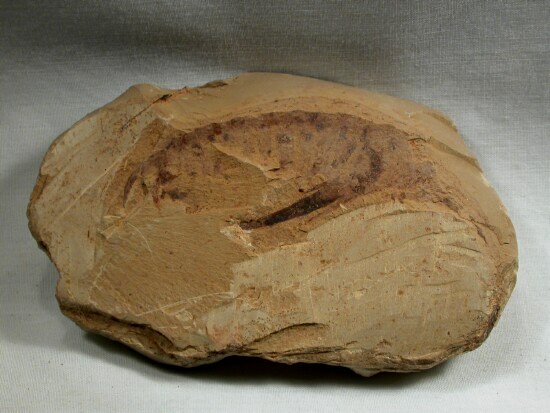
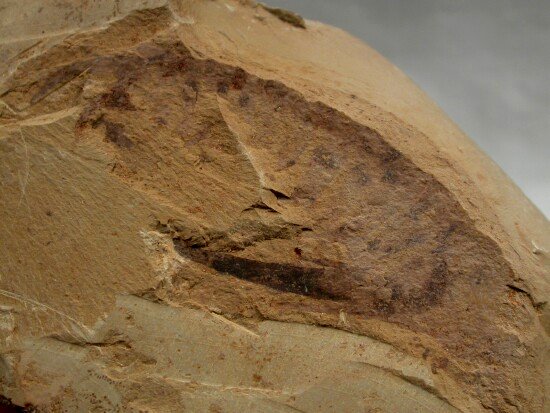
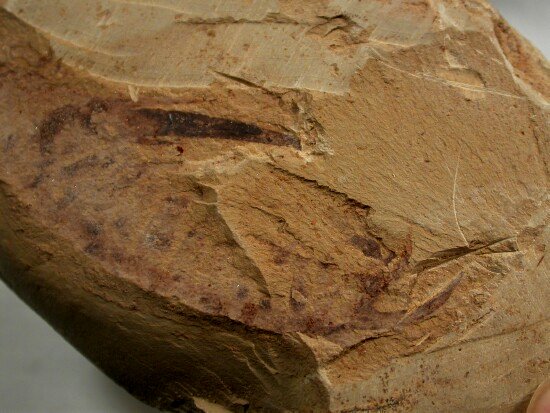
 This
is the grasping appendage of the so called “Terror of the
Cambrian”,
Anomalocaris saron. The enigmatic Anomalocaris
is known from Asia, Australia, Europe, and North America,
and is
thought by many to be closely related to Arthropods. The spiniferous
grasping appendages are strongly supporting of a carnivorous
lifestyle. Trilobite fossils from Utah
often show evidence of bite marks that have been made by Anaomalocaris.
Anomalocaris saron is only known from the Chengjiang biota,
but is likely closely
related
to Anomalocaris canadensis, the type species, from the younger
Burgess Shale and Utah. The genus derives its name from “anomalous
shrimp”, which
was what the describer thought the appendage was. This
is the grasping appendage of the so called “Terror of the
Cambrian”,
Anomalocaris saron. The enigmatic Anomalocaris
is known from Asia, Australia, Europe, and North America,
and is
thought by many to be closely related to Arthropods. The spiniferous
grasping appendages are strongly supporting of a carnivorous
lifestyle. Trilobite fossils from Utah
often show evidence of bite marks that have been made by Anaomalocaris.
Anomalocaris saron is only known from the Chengjiang biota,
but is likely closely
related
to Anomalocaris canadensis, the type species, from the younger
Burgess Shale and Utah. The genus derives its name from “anomalous
shrimp”, which
was what the describer thought the appendage was.
Also
see: Chengjiang
Biota, Chengjiang
Fossils, Cambrian
Explosion
|