What Are Transitional Fossils
 Transitional
fossils are the fossilized remains of transitional forms of
life
that tangibly and demonstrably encode an evolutionary transition.
Thus, transitional fossils are characterized by their retention
of primitive (plesiomorphic) traits in contrast with their
more
recently evolved characteristics (the phenotype and genotype). Transitional
fossils are the fossilized remains of transitional forms of
life
that tangibly and demonstrably encode an evolutionary transition.
Thus, transitional fossils are characterized by their retention
of primitive (plesiomorphic) traits in contrast with their
more
recently evolved characteristics (the phenotype and genotype).
The
term "missing link" is a popular slang term for such
transitional forms, but is misleading. The term is particularly
used in popular media, but is inaccurate and confusing, partly
because it implies that there exists a single undiscovered fossil
that is needed to confirm the transition. In contrast, the continual
discovery of more and more transitional fossils is further refining
and validating evolutionary transitions. Transitional fossils
are numerous and varied throughout the tree of life, including
those between primates and early humans, contrary to the claims
of creationists who deny evolution.
Evolutionary
theory considers all populations of organisms to be in transition,
whether changes be slow, as in genetic drift, or fast, as when
a changing environment imposes significant adaptive pressures.
A transitional form of life is one that demonstably illustrates
a particular intermediate evolutionary stage of change or adaptation.
Transitional fossils usually coexist with gaps in a sequence in
the fossil record. The probabilities of fossilization pretty much
precludes the discovery of detailed sequences of fossils spanning
millions of years. However, fine gradations of fossils between
species and genera are abundant in the fossil record, as are coarser
sequences between higher taxa.
Fossil
transitionals between kingdoms and phyla:
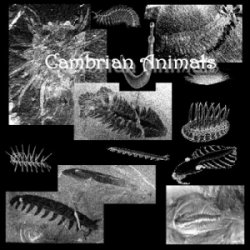
The Cambrian fossils Halkiera and Wiwaxia have features that
connect them with each other and with the modern phyla of Mollusca, Brachiopoda,
and Annelida.
In particular, one species of halkieriid has brachiopod-like
shells on the dorsal side at each end. This is seen also
in an
immature stage of the living brachiopod species Neocrania.
It has setae identical in structure to polychaetes, a group
of annelids.
Wiwaxia and Halkiera have the same basic arrangement of hollow
sclerites, an arrangement that is similar to the chaetae
arrangement
of polychaetes. The undersurface of Wiwaxia has a soft sole
like a mollusk's foot, and its jaw looks like a mollusk's
mouth. Aplacophorans,
which are a group of primitive mollusks, have a soft body covered
with spicules similar to the sclerites of Wiwaxia (see Conway
Morris
1998, 185-195).
Cambrian
and Precambrain fossils Anomalocaris and Opabinia are transitional
between arthropods and lobopods.
Tentative List of Transitional Fossils
Invertebrate to Vertebrate Unnamed Upper (U.) Pre-Cambrian chordate — First
to bear a primitive notochord; archaetypical chordate.
Pikaia gracilens — Middle (M.) from Burgess Shale - a Cambrian
chordate with lancelet-like morphology.
Haikouella— Lower (L.) Cambrian chordate, first to bear
a skull; archaetypical craniate.
Haikouichthys— L. Cambrian quasi-vertebrate, intermediate
in developing a vertebral column; archaetypical vertebrate.
Conodonts— U. Cambrian to Triassic quasi-vertebrates with
spinal cord; “bug-eyed lampreys”.
Myllokunmingia— L. Cambrian vertebrate with primitive spinal
column; oldest true crown-group vertebrate.
Arandaspis— L. Ordovician vertebrate, armoured jawless
fish (ostracoderm), oldest known vertebrate with hard parts known
from (mostly) complete fossils.
Jawless Fish to Jawed Vertebrate
Birkenia— Silurian primitive, jawless fish,
a typical member of the Anaspida
Cephalaspis— Silurian armoured jawless fish, archaetypical
member of the “Osteostraca,” sister group to all
jawed
vertebrates.
Shuyu— Silurian to Devonian, armoured jawless fish belonging
to Galeaspida, related to Osteostraca. Internal cranial
anatomy very similar to the anatomy seen in basal jawed vertebrates.
This similarity is directly implied with the translation
of its name, “Dawn Fish,” with the implication that
it represents the “dawn of jawed vertebrates.”
Acanthodian to shark
Ptomacanthus— sharklike fish, originally
described as an acanthodian fish: brain anatomy demonstrates
that it is an
intermediate between acanthodians and sharks.
Cladoselache— primitive/basal shark.
Tristychius— another sharklike fish.
Ctenacanthus— primitive/basal shark.
Paleospinax— sharklike jaw, primitive teeth.
Spathobatis— Ray-like fish.
Protospinax— Ancestral to both sharks and skates.
Primitive jawed fish to bony fish
Acanthodians— superficially similar to
early bony fishes, and some have been identified as being the
ancestors of sharks.
Palaeoniscoids — the first primitive bony fishes - see
example from Bear Gulch
Canobius, Aeduella— palaeoniscoids with more advanced jaws.
Parasemionotus— combination of modern cheeks with more
primitive features, like lungs
Oreochima— first teleost fish
Leptolepids— vaguely herring-like ancestors of modern teleost
fish. Lung modified into swim bladder.
Amphistium and Heteronectes— percomorphs that demonstrate
the transition of the eye location of flatfishes.
Fish to amphibian
Paleoniscoids— both ancestral to modern
fish and land vertebrates.
Osteolepis— modified limb bones, amphibian like skull and
teeth.
Kenichthys— shows the position of exhaling nostrils moving
from front to fish to throat in tetrapods in its halfway point,
in
the teeth
Eusthenopteron, Sterropterygion— fin bones similarly structured
to amphibian feet, but no toes yet, and still fishlike bodily
proportions.
Panderichthys, Elpistostege— tetrapod-like bodily proportions.
Obruchevichthys— fragmented skeleton with intermediate
characteristics, possible first tetrapod.
Tiktaalik— a fish with developing legs. Also appearance
of ribs and neck.
Acanthostega gunnari— famous intermediate fossil. most
primitive fossil that is known to be a tetrapod
Ichthyostega— like Acanthostega, another fishlike amphibian
Hynerpeton— A little more advanced then Acanthostega and
Ichtyostega
Labyrinthodonts— still many fishlike features, but tailfins
have disappeared
Lungfish—A fish-that has lungs.
Primitive to modern amphibians
Temnospondyls
Dendrerpeton acadianum
Archegosaurus decheni
Eryops megacephalus
Trematops
Amphibamus lyelli
Doleserpeton annectens
Triadobatrachus— primitive frog
Vieraella
Karaurus— primitive salamander
Amphibian to reptile
Proterogyrinus
Limnoscelis
Tseajaia
Solenodonsaurus
Hylonomus
Paleothyris
Early reptile to turtle
Captorhinus
Scutosaurus
Odontochelys Semitestacea— partial formation of a turtle
shell, showing how the hard underbelly, or plastron, formed first.
Deltavjatia vjatkensis
Proganochelys
Early reptile to diapsid (dinosaurs and modern reptiles except
for turtle)
Hylonomus
Paleothyris
Petrolacosaurus
Araeoscelis
Apsisaurus
Claudiosaurus
Planocephalosaurus
Protorosaurus
Prolacerta
Proterosuchus
Hyperodapedon
Trilophosaurus
Reptile to mammal
Paleothyris
Protoclepsydrops haplous
Clepsydrops
Archaeothyris
Varanops
Haptodus
Dimetrodon
Sphenacodon
Biarmosuchia
Procynosuchus
Dvinia
Thrinaxodon
Cynognathus
Diademodon
Probelesodon
Probainognathus
Exaeretodon
Oligokyphus
Kayentatherium
Pachygenelus
Diarthrognathus
Adelobasileus cromptoni
Sinoconodon
Kuehneotherium
Eozostrodon
Morganucodon— a transition between “mammal-like reptiles” and “true
mammals”.
Haldanodon
Peramus
Endotherium
Kielantherium
Aegialodon
Steropodon galmani
Vincelestes neuquenianus
Pariadens kirklandi
Kennalestes
Asioryctes
Cimolestes
Procerberus
Gypsonictops
Dinosaur to bird
Allosaurus—A large therapod with a wishbone
Coelophysis
Compsognathus—A small coeleosaur with a wishbone
Eoraptor
Epidendrosaurus
Herrerasaurus
Ceratosaurus
Compsognathus
Sinosauropteryx
Protarchaeopteryx
Caudipteryx
Velociraptor
Deinonychus
Oviraptor
Sinovenator
Beipiaosaurus
Lisboasaurus
Sinornithosaurus
Microraptor— a feathered bird with distinctly dinosaurian
characteristics, such as its tail.
Xiaotingia— slightly earlier than Archaeopteryx, slightly
more like a dinosaur and less like a bird
Archaeopteryx— the famous bird-with-teeth.
Rahonavis
Confuciusornis
Sinornis
Patagopteryx
Ambiortus
Hesperornis
Apsaravis
Ichthyornis
Columba— One of many typical modern birds
Primates
Darwinius masillae— a link between earlier
primates and later ones.
Non-human primate to human
Sahelanthropus tchadensis— One of the oldest
known species in the human family tree. Lived around 6.5-7
million years
ago, one of the earliest bi-pedal fossils.
Orrorin tugenensis— Over 20 fossils of the 6 million year
old species have been found and show very human-like
morphology.
Ardipithecus ramidus— 4.5 million year old species showing
bi-pedal adaptations and opposable thumbs.
Australopithecus— a genus of bipedal apes
Australopithecus anamensis
Australopithecus afarensis
Kenyanthropus platyops— 3.5 million year old himinim fossil,
most likely a subspecies of Australopithecus
Australopithecus africanus
Australopithecus garhi
Australopithecus sediba— advanced australopithecus showing
more human features
Australopithecus aethiopicus
Australopithecus robustus
Australopithecus boisei
Homo habilis— a transitional form from Australopithecus
to later Homo
Homo rudolfensis— a type of Homo habilis or a different
species
Homo ergaster— a form of Homo erectus or a distinct species
Homo georgicus— a form of Homo Erectus or a distinct species
Homo erectus— a transitional form from Australopithecus
to later Homo (Latin for humans) species
Homo antecessor— is an extinct human species, or subspecies,
dating from 1.2 million to 800,000 years ago
Homo heidelbergensis— A possible common ancestor of modern
man and homo neanderthalensis
Homo neanderthalensis— They may or may not have done Humpy
bumpy with modern humans.
Homo floresiensis— Extinct Homo species, living 94,000-12,000
years ago, used tools, bipedal, very human-like
Cro-magnon— considered early modern human and perhaps as
smart as we are
Cetaceans
Indohyus— a vaguely chevrotain-like or
raccoon-like aquatic artiodactyl ungulate with an inner ear
identical to that of
whales.
Ambulocetus— an early whale that looks like a mammalian
version of a crocodile
Pakicetus— an early, semi-aquatic whale, a superficially
wolf-like animal believed to be a direct ancestor of modern whales.
Rhodocetus— An early whale with comparatively large hindlegs:
not only represents a transition between semi-aquatic
whales, like Ambulocetus, and obligately aquatic whales, like
Basilosaurus.
Basilosaurus— A large, elongated whale with vestigial hind
flippers: transition from early marine whales (likeRhodocetus)
to
modern whales
Dorudon— A small whale with vestigial hind flippers, close
relative of Basilosaurus.
List
reference: Eclectic Irony
Wikipedia has an extensive section listing notable transitional
fossil sequences. |