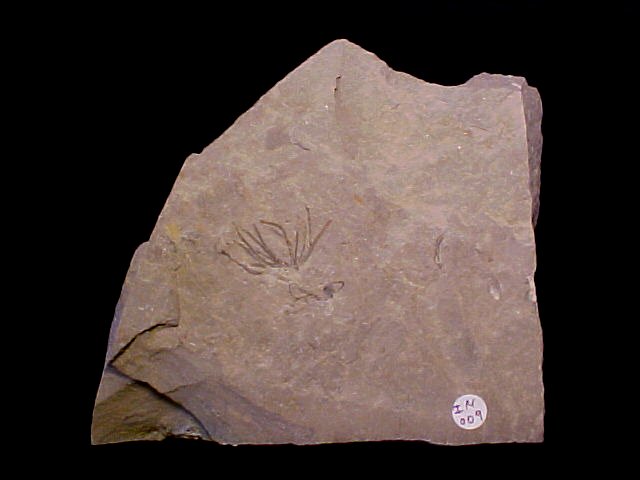
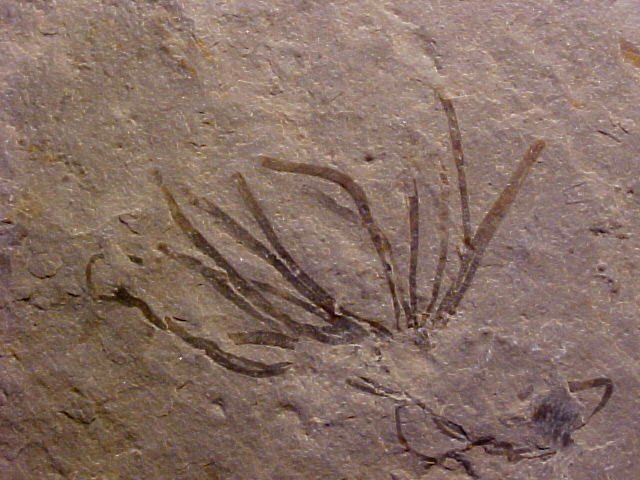
|  This
is as particularly well preserved specimen of the genus Yuknessia
from the famous Wheeler Formation of Utah. Yuknessia
from the Cambrian is now interpreted as an early deuterostome
metazoan,
a group
that
includes
Chordates, Hemichordata, Echinodermata,
Xenoturbellida and Vetulicolia,
and is placed in Class
Pterobranchia. Pterobranchs are extant today, generally as planktonic
filter feeders living on the deep ocean floor. More recent research
place Pterobranchs within the extinct Graptolite clade of Phylum
Hemichordata. These animals were participants in the great metazoan
radiation known as the Cambrian
Explosion. The genus is known from The Burgess Shale, Chengjiang
and several Utah Lagerstätte
fossil sites. This
is as particularly well preserved specimen of the genus Yuknessia
from the famous Wheeler Formation of Utah. Yuknessia
from the Cambrian is now interpreted as an early deuterostome
metazoan,
a group
that
includes
Chordates, Hemichordata, Echinodermata,
Xenoturbellida and Vetulicolia,
and is placed in Class
Pterobranchia. Pterobranchs are extant today, generally as planktonic
filter feeders living on the deep ocean floor. More recent research
place Pterobranchs within the extinct Graptolite clade of Phylum
Hemichordata. These animals were participants in the great metazoan
radiation known as the Cambrian
Explosion. The genus is known from The Burgess Shale, Chengjiang
and several Utah Lagerstätte
fossil sites.
Fossils
of Yuknessia were first described as multicellular, photosynthetic
green algae
(Chlorophytes), with two
species from the Burgess Shale Yuknessia simplex and Yuknessia stephenensis.
LoDuca, et al., transferred the genus in 2015 from Algae to Pterobranchia in
Phylum
Hemichordata.
Also
see: Utah Cambrian Explosion
Fossils
References:
- The
Fossils of the Burgess Shale by D. E. Briggs, et al.
- Steven T. LoDuca, Jean-Bernard Caron, James D.
Schiffbauer, Shuhai Xiao and Anthony Kramer (2015). "A reexamination of Yuknessia
from the Cambrian of British Columbia and Utah". Journal of
Paleontology 89 (1): 82–95.
- Sato, A; Rickards RB; Holland PWH (2008). "The origins of graptolites
and other pterobranchs: a journey from 'Polyzoa'". Lethaia 41
(4): 303–316.
- Fortey, Richard A. (1998). Life: A Natural History of the First
Four Billion Years of Life on Earth. New York: Alfred A. Knopf.
p. 129.
- Mitchell, C. E.; Melchin, M. J.; Cameron, C. B.;
Maletz, J. R. (2012). "Phylogenetic
analysis reveals that Rhabdopleura is an extant graptolite".
Lethaia 46: 34.
|