Black
Cat Mountain Trilobites of Oklahoma
Oklahoma
is remarkable in terms of its representation of formations
spanning much of geological history. The Paleozoic is
also well-represented, and some of the most spectacular
trilobites that originate from within the boundaries of
the United States come from Lower Devonian formations
in Coal County, Oklahoma, located near the tip of the
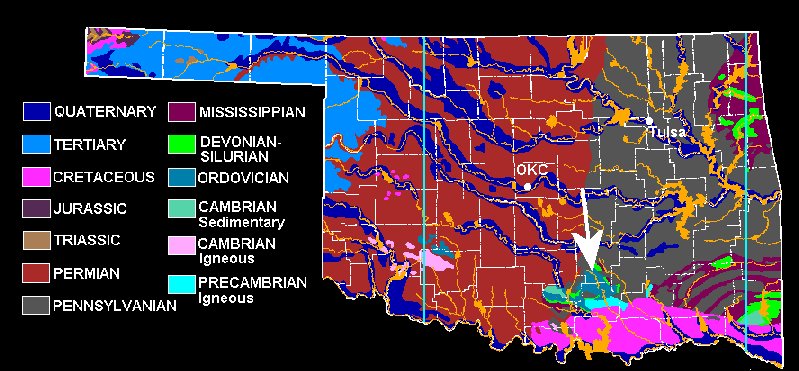
white arrow on the map (click the map to enlarge).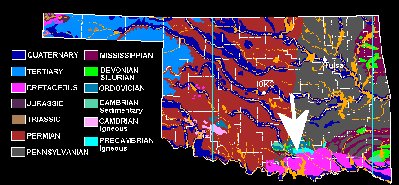 This map correlates location and age of the Oklohoma geology.
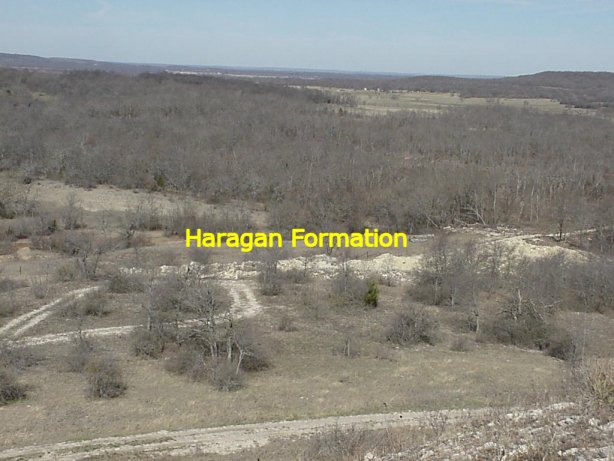
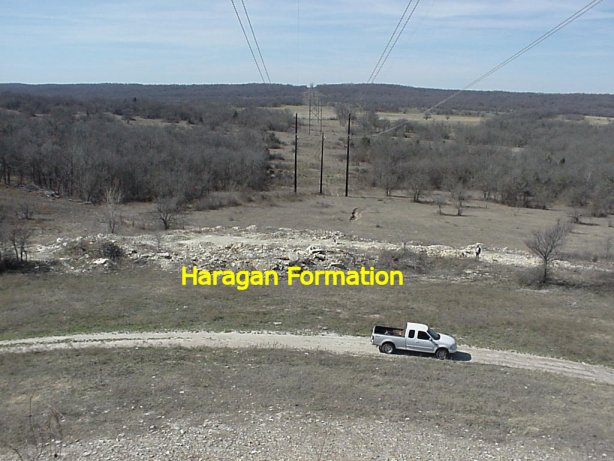
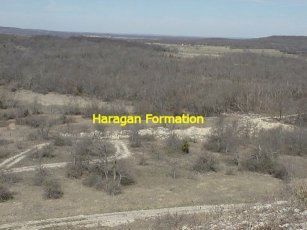
Closest to the Devonian Haragan and Bois d' Arc fformation
is the town is Clarita, which amounts to little more than
a few humble residences and a post office. Three commercial
quarries operate and supply a steady, if sometimes minimal,
supply of 19 different trilobite species. The two primary
formations are the Haragan and Bois d' Arc, with soft
limestone that yields with proper equipment and skilled
operator beautiful honey-colored trilobites of a shade
and quality resembling those from the Saint
Petersburg region of Russia.
This map correlates location and age of the Oklohoma geology.
Closest to the Devonian Haragan and Bois d' Arc fformation
is the town is Clarita, which amounts to little more than
a few humble residences and a post office. Three commercial
quarries operate and supply a steady, if sometimes minimal,
supply of 19 different trilobite species. The two primary
formations are the Haragan and Bois d' Arc, with soft
limestone that yields with proper equipment and skilled
operator beautiful honey-colored trilobites of a shade
and quality resembling those from the Saint
Petersburg region of Russia.
 Interestingly,
the Devonian trilobites of Oklahoma have look-a-likes found
in the Atlas Mountains of Morocco. While today on continents
separated by thousands of miles, such was not the case during
Devonian-time. During the Interestingly,
the Devonian trilobites of Oklahoma have look-a-likes found
in the Atlas Mountains of Morocco. While today on continents
separated by thousands of miles, such was not the case during
Devonian-time. During the 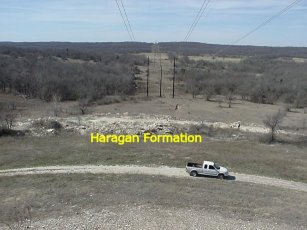 Devonian,
present-day Morocco was part of the Eastern continental
shelf of Gondwana, and present-day Oklahoma was part of
the Southern continental shelf of Euramerica. These locations
were adjacent and at essentially equal latitudes and probably
had nearly identical environments. Thus, each of the comparable
species undoubtedly shares a common ancestry and is classified
in the same genera. The Table below lists the species found
in Devonian of Oklahoma, as well as information on classification
and relative frequency. Devonian,
present-day Morocco was part of the Eastern continental
shelf of Gondwana, and present-day Oklahoma was part of
the Southern continental shelf of Euramerica. These locations
were adjacent and at essentially equal latitudes and probably
had nearly identical environments. Thus, each of the comparable
species undoubtedly shares a common ancestry and is classified
in the same genera. The Table below lists the species found
in Devonian of Oklahoma, as well as information on classification
and relative frequency.
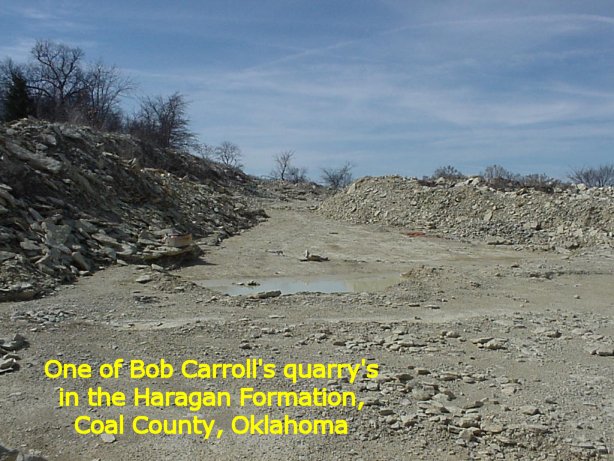
Mr.
Robert Carroll has operated one of the commercial quarries
in the area for the past dozen years. Actually, he works
several quarries that have exposures of both the Haragan
and Bois d' Arc Formations. I have hunted in these quarries,
and the process is markedly different from hunting the Great
Basin in the Western U.S. While surface hunting is possible
for trilobites weathering out of matrix, if your goal is
an exquisite specimen, you'll have to do a lot of rock splitting.
 The
trilobites are discovered by their very thin cross sections
(hence, the trilobite will already be in two or more pieces).
Expert eyes like Bob's are usually required to ID the species
and to estimate whether it is possible that the matrix may
contain a complete specimen. Most are not complete. If it
can not be determined that it is incomplete, the next step
is to take it back to the prep lab and rough it out with
a pneumatic chisel. The exception is the complete specimen
which is then finished using air abrasive tools. The trilobites
that come from Bob's lab are exquisite in every respect,
and each one represents prodigious hours of preparation.
The good news is that the limestone matrix melts away under
AlO2 grit at 100 psi pressure, yielding a life-like specimen
that is a darker brown than the matrix. The
trilobites are discovered by their very thin cross sections
(hence, the trilobite will already be in two or more pieces).
Expert eyes like Bob's are usually required to ID the species
and to estimate whether it is possible that the matrix may
contain a complete specimen. Most are not complete. If it
can not be determined that it is incomplete, the next step
is to take it back to the prep lab and rough it out with
a pneumatic chisel. The exception is the complete specimen
which is then finished using air abrasive tools. The trilobites
that come from Bob's lab are exquisite in every respect,
and each one represents prodigious hours of preparation.
The good news is that the limestone matrix melts away under
AlO2 grit at 100 psi pressure, yielding a life-like specimen
that is a darker brown than the matrix.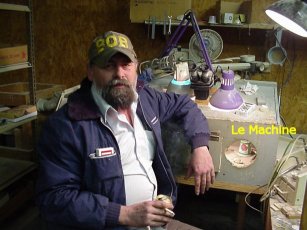 The
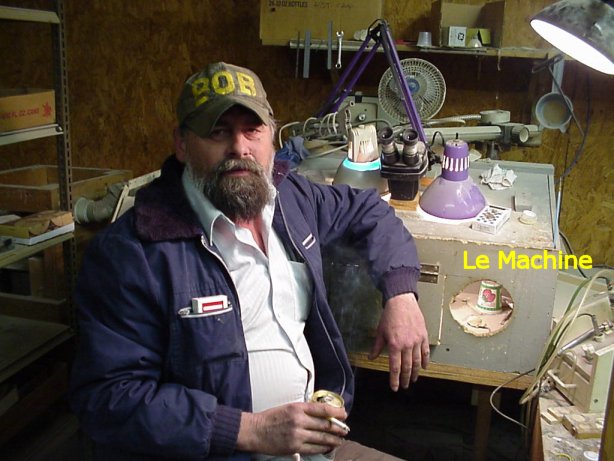
picture below shows Bob setting by his circa 1953 White
air abrasion machine. As old as it is, it is meticulously
maintained. Bob's preparation is a source a pride, and examples
of his work can, for example be found in Riccardo Levi-Setti's
book, Trilobites. The
picture below shows Bob setting by his circa 1953 White
air abrasion machine. As old as it is, it is meticulously
maintained. Bob's preparation is a source a pride, and examples
of his work can, for example be found in Riccardo Levi-Setti's
book, Trilobites.
The
Table below lists the 20 Devonian trilobite species found
to occur in the Haragan and Bois d' Arc Formations, 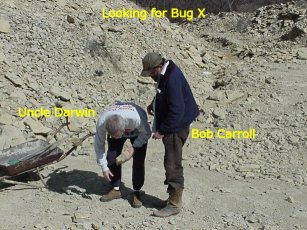 Links are also provided where you will find more information
and pictures for many of the species. Some of these trilobites
are exceedingly rare and and only known from fragments.
In this case the species listed is a similar trilobite occuring
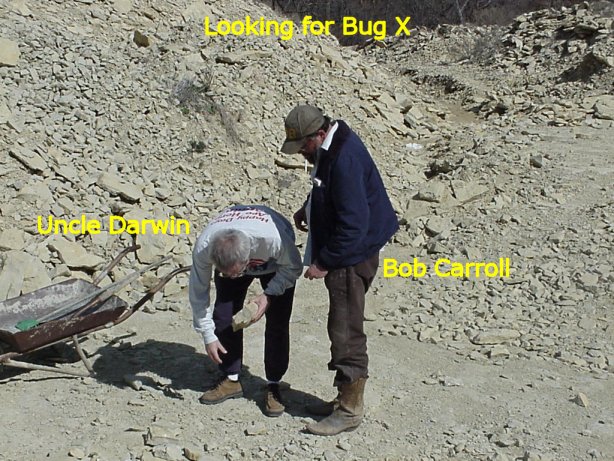
elsewhere. Cyphaspis
carrolli, a diminuative Aulocopleurid, is named for
Bob Carroll. Bob is also credited for the discovery of a
rare petite lichid trilobite recently determined to be Acathopyge
consanguinea (also knoen from New York),
and which Bob affectionately called Bug
X. As previously mentioned, Morroco and Oklahoma were
proximal during Devonian time, such that some trilobite
genera are common to both Coal County and the Moroccan Atlas
Mountains. The Oklohoma species tend to be smaller and,
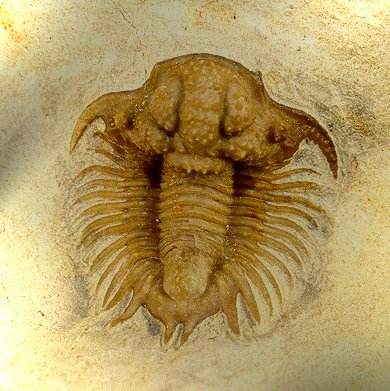
I believe, more elegant. A perfect example is the highly
sought Odontopleurid genus, Dicranurus. The Morrocan species
is named Dicranurus
monstrosus, (a favorite among the fake
fossils producers of Northern Africa) and the Oklahoma
species Dicranurus
elegantus - it appears that the names pretty much tell
it all.
Links are also provided where you will find more information
and pictures for many of the species. Some of these trilobites
are exceedingly rare and and only known from fragments.
In this case the species listed is a similar trilobite occuring
elsewhere. Cyphaspis
carrolli, a diminuative Aulocopleurid, is named for
Bob Carroll. Bob is also credited for the discovery of a
rare petite lichid trilobite recently determined to be Acathopyge
consanguinea (also knoen from New York),
and which Bob affectionately called Bug
X. As previously mentioned, Morroco and Oklahoma were
proximal during Devonian time, such that some trilobite
genera are common to both Coal County and the Moroccan Atlas
Mountains. The Oklohoma species tend to be smaller and,
I believe, more elegant. A perfect example is the highly
sought Odontopleurid genus, Dicranurus. The Morrocan species
is named Dicranurus
monstrosus, (a favorite among the fake
fossils producers of Northern Africa) and the Oklahoma
species Dicranurus
elegantus - it appears that the names pretty much tell
it all.
| Devonian
Devonian Trilobites of the Oklahoma
Haragan Formation and
Bois d' Arc Formation |
| Name |
Classification |
Occurence |
Moroccan Trilobite Counterpart |
Order
Lichida |
|
Order Lichida
Family Lichidae
|
Haragan
& Bois d' Arc, Extremely rare |
na |
|

Order Lichida
Superfamily Lichoidea
Family Odontopleuridae |
Only
one complete specimen known |
? |
|
Suborder Lichina
Superfamily Odontopleurida Family Selenopeltidae
|
Haragan,
Rare |
|
|
Suborder Lichina
Superfamily Odontopleurida Family Odontopleuridae
|
Haragan,
Fairly common |
Leonaspis
sp. |
Ceratonurus |
Order
Lichida
Superfamily Odontopleurida
Family Odontopleuridae |
Haragan,
Rare |
na |
Echinolichas
coccymelum |
Order
Lichida
Superfamily Odontopleuroidea
Family Lichidae |
Haragan
& Bois d' Arc, fragments only |
? |
Echinolichas
bigsbyi |
Order
Lichida
Superfamily Odontopleuroidea
Family Lichidae |
Haragan
& Bois d' Arc, fragments only |
na |
Order
Protida |
|
Order
Proetida
Suborder Proetina
Superfamily Aulacopleuroidea Family Aulacopleuridae
|
Scarce |
na |
|
Suborder
Proetina
Superfamily Aulacopleuroidea
Family Brachymetopidae
|
Haragan,
Scarce |
na |
Cordania
wessmani |
Suborder
Proetina
Superfamily Aulacopleuroidea
Family Brachymetopidae |
Bois
d' Arc, Rare |
na |
Harpidella
sp. |
Suborder
Proetina
Superfamily Aulacopleuroidea Family Aulacopleuridae |
Exceedingly
rare |
na |
Otarion
axitiosum |
Suborder
Proetina
Superfamily Aulacopleuroidea Family Aulacopleuridae |
Haragan,
fragments only |
Otarion
sp. |
Order
Phacopida |
Huntoniatonia
oklahomae |
Suborder
Phacopina
Superfamily Dalmanitoidea
Family Dalmanitidae |
Haragan,
Scarce |
Odontochile
sp. |
|
Suborder
Phacopina
Superfamily Dalmanitoidea
Family Dalmanitidae |
Bois
d' Arc, Scarce |
na |
|
Suborder
Phacopina
Superfamily Dalmanitoidea
Family Dalmanitidae |
Haragan,
Rare |
na |
Odontochile
syncrama |
Suborder
Phacopina
Superfamily Dalmanitoidea
Family Dalmanitidae |
Exceedingly
rare |
na |
|
Order
Phacopida
Suborder Phacopina
Superfamily Phacopoidea
Family Phacopidae |
Haragan
& Bois d' Arc, Common |
na |
|
Order
Phacopida
Suborder Phacopina
Superfamily Phacopoidea
Family Phacopidae |
Haragan,
Fairly common |
Reedops
maurulus |
|
Order
Phacopida
Suborder Phacopina
Superfamily Phacopoidea
Family Phacopidae |
Bois
d' Arc, Scarce |
Phacops
sp. |
Order
Corynexochida |
Scutellum
sp. |
Scabriscutellum
furficerum |
Haragan,
Exceedingly rare |
Scutellum
sp. |
|
|
| |